Showing posts with label Region--Castle Country. Show all posts

Tuesday, June 2, 2020

Unemployment Insurance Claims Data Shed Light on the Local Economic Impacts of COVID-19 Public Health Directives


By Lyndsey Stram, Regional Economist; Lecia Parks Langston, Senior Economist


“You have power over your mind — not outside events. Realize this, and you will find strength.” Marcus Aurelius

In the wake of the COVID-19 pandemic, businesses lost revenues and workers lost jobs. But because of the time it takes to collect and collate data, economists have been left without much information to quantify the economic impacts at the local level.

But there is one ray of data illumination. Claims for unemployment benefits are promptly available and provide information about a large cross section of the economy. This post will outline what light unemployment claims data sheds on the state of the Castle Country Region’s economy.

While not all workers are protected by unemployment insurance laws, roughly 95% of jobs are covered. This makes claims data an exceptional source of information about the economy. Not included under unemployment insurance laws are most self-employed workers, about half of agricultural employment, unpaid family workers, railroad personnel (covered separately) and many nonprofit organizations (such as churches). Also, some out-of-work employees may not have worked a sufficient work history to qualify for unemployment insurance benefits, but may file anyway.

Fortunately, in this time of economic distress, the social safety nets of the unemployment insurance program, special national COVID-19 funding and social programs are working together to keep workers’ income and well-being stable.

Unemployment claimants and the unemployed; they aren’t the same

Also, keep in mind that, in addition to individuals drawing unemployment benefits, the unemployment rate includes those entering and re-entering the workforce and non-covered groups without current employment. This means the number of “unemployed” will be greater than the number of claimants. In “normal” times, only about 40% of the “unemployed” are claiming benefits.

The generally reported unemployment rate also has a work-search requirement. If you haven’t made any minimal attempts to find work, you aren’t counted as “unemployed.”

Watch this Space

While this analysis won’t be updated on a regular basis, new data will be added to the data visualization on a weekly basis allowing readers to check back for the latest information.

An Unprecedented Event

Not surprisingly, first-time claims for unemployment benefits soared in Utah and across the nation as the pandemic swept across the country. This increase is unprecedented since the creation of unemployment insurance coverage during the Great Depression. Week 12 (beginning March 16) marks the start of this unparalleled surge in claims. On a positive note, while new claims for unemployment benefits have skyrocketed in Utah, the state currently shows one of the lowest claims rates in the nation.

Emery County saw its peak in first-time claims in week 13 and Carbon County saw its peak in week 14, the first and second weeks after the COVID-19 pandemic hit. Both counties have seen initial claims drop sharply since then. Carbon County, however, did have another uptick in week 19. Both of the Castle Country counties are now down to initial claims levels comparable to those that occurred in 2009 during the Great Recession.

Who took the hardest hit?

The largest industry shares of initial claims filed in the region belonged to healthcare/social assistance. Tourism is the industry suffering the most right now in many areas and accommodation/food service claims also account for over 15% in the region.

In the initial weeks of the pandemic, many claims (135, or 15% in Castle Country) were filed in unknown industry. Most likely many of these can be accounted for by the healthcare/social assistance and accommodation/food services sectors.

Tourism and COVID-19

Especially in the early stages of the restrictions, this is a story of tourism-dependent industries. Approximately 16% of COVID-19 initial claims filed in Castle Country represented workers previously employed accommodations and food services. In Carbon County, 14% of the total claims, and 21% of the claims in Emery County, belong to the accommodation/food service sector.

Industry Flow

While most of the high-claim industries felt the pain of the pandemic early on, other industries surged in later weeks. As the economic effects of other closures worked their way through the economy, wholesale trade proved to be a latecomer to the layoffs in Castle Country, partially responsible for the spike in claims in week 19.

The High and Low

Although healthcare/social assistance and accommodations/food services have generated the largest number of claims in the region during the COVID-19 time period, in percentage terms, other industries have suffered more. For example, 38% of the administrative support/waste management/remediation workforce (which includes temporary employment firms) have filed a claim for unemployment benefits. More than 20% of both the real estate/rental/leasing and management of companies sectors have filed for benefits, as well.

Other industries have been able to hold on to larger shares of their workforces. Construction has seen extremely low filing percentages, as well as manufacturing. Surprisingly, retail trade in Castle

Country also accounts for a small portion of the claims. This is likely due to a large share of the retail trade in rural areas being deemed “essential” and allowed to remain open.

County by County

Carbon County
• Prior to the COVID-19 pandemic, Carbon County averaged 10 first-time claims per week, this has now increased to 86.
• First-time claimants, as a share of covered employment in Carbon County, has remained lower than the state average at 8%.
• A majority of the claims filed in Carbon County belong to the healthcare/social assistance sector as elective medical services were halted during the peak of COVID-19 concerns in the area.
• Before the COVID-19 pandemic, Carbon County accounted for 63% of the initial claims for unemployment in the region. It accounted for 75% during the pandemic.

Emery County
• Prior to the COVID-19 pandemic, Emery County averaged six first-time claims per week and has increased to 28 on average in the weeks since.
• First-time claimants, as a share of covered employment in Emery County, has remained lower than the state average at 7%.
• Like much of the state, the majority of the claims in Emery County belong to the accommodation/food services and healthcare/social assistance sectors.
• Before the COVID-19 pandemic, Emery County accounted for 37% of the initial claims for unemployment in the region. It accounted for 25% during the pandemic.

Wednesday, November 4, 2015

Reviewing the 2012 Agricultural Census for Castle Country

<

Scott Smith, Regional Economist

The 2012 Census of Agriculture is just that — a census. It is an attempt to count an entire population and generally does not use sampling or statistical techniques to make conclusions. It is conducted every five years and includes all farm operators regardless of whether farming is their primary or secondary occupation. Operators and hired laborers are combined for a total count. There can be a maximum of three operators per farm, but labor hired on a contract basis is not covered.

Castle Country agriculture is focused on the production of livestock and associated feedstock. Almost 90 percent of Carbon County agricultural land is classified as pasture and rangeland. Emery County is a bit different. It is just over 50 percent pasture and rangeland, and 26 percent cropland. The remainder is woodland and other. 2012 net cash income per farm for the two counties was $1.4 million and $140,000 respectively. The bulk of the region’s farms have total annual sales of less than $250,000.

Castle Country farm employment in the 2012 census was 1,944. As noted above, the census counts workers whose primary and secondary source of income is agriculture. Additional data sources reveal that the vast majority of the Castle Country farm workforce has primary jobs outside of agriculture. The size and composition of the agricultural workforce has changed markedly over time. In 2002, the total labor force was 1,732 of which 37 percent was hired labor. The total agricultural workforce increased by 11 percent by 2007 to 1,914, but the number of hired laborers actually declined to 29 percent. The analogous figures for 2012 are 2 percent and 24 percent.

There is an obvious trend away from hired employment. The reason for this can be gleaned from expense data. In 2002, the labor cost per worker (as defined by dividing annual labor expense by the hired workforce) was $2,690. In 2007, the cost had risen 27 percent to $3,320. In 2012, this number had increased by 21 percent to $4,140. In contrast, inflation increased by 15 percent and 9 percent respectively, as of the 2007 and 2012 censuses. Faced with higher real (inflation adjusted) labor costs, operators appear to have substituted to their own labor or made investments in capital goods.

The number and character of Castle Country operators has displayed an interesting combination of volatility and adherence to the trend. There were 724 principal operators in the Castle Country in 2002 (the statistics refer to “principal” operator and therefore will not agree with other totals). The number of operators increased by 23 percent to 887 operators in 2007, and then remained essentially unchanged as of the 2012 count. Similarly, in 2007, the proportion of operators who rely on other sources of income shot up to 68 percent from 55 percent in 2002. The share returned to 55 percent in the 2012 census.

Analysts speculate that the changes are in response to fluctuations in farm income. In 2002, net cash income per operator was $2,887. Operators suffered a loss of $484 in 2007, and generated a gain of only $345 in 2012. Farming takes some capital investment, and the proprietorship of an ongoing enterprise is somewhat “sticky” — operators are loath to walk away from their investments. Presumably, the large gains generated in 2002 attracted market participants who stayed around to experience a loss in 2007. That loss and the rather meager gain generated in 2012 were insufficient to attract any more participants into the industry. Similarly, the losses generated in 2007 made it necessary for some operators to seek other sources of income. The small gain of 2012 was sufficient to reduce the share of “full time” operators back to its historic norm.

Monday, April 27, 2015

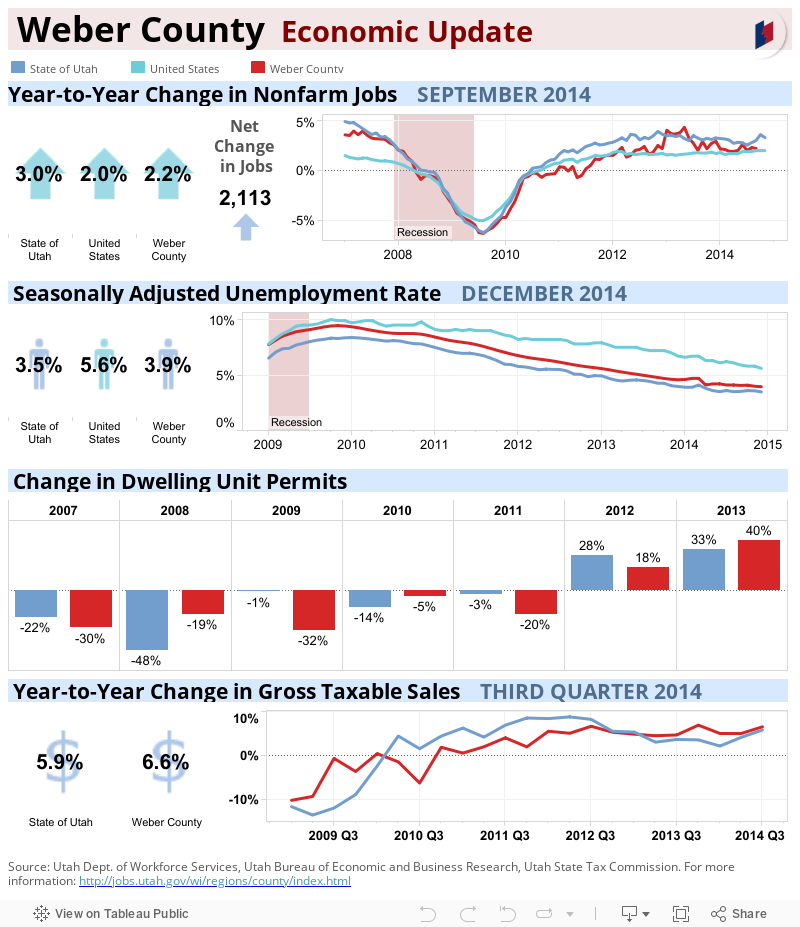
Carbon County Economic Update

Tyson Smith, Regional Economist

The Utah Department of Workforce Services (DWS) relies on several data sources to help describe the state of the economy. The most accurate data available is the nonfarm payroll employment information that is collected through the Quarterly Census of Employment and Wages. However, the resources required to gather data accurately come at the expense of timeliness, which results in a four to six month lag between the time these data are collected and when they are available to the public.

Other data are collected in a timelier manner, and these data (along with historical trends) provide a foundation to estimate current economic conditions. Economists at DWS rely heavily upon statistical models, surveys, and limited datasets to evaluate the economy in real-time. Some of those tools, like the county unemployment rates and initial weekly unemployment claims, are highlighted in this article.

The truth is that no single source of economic data exists that can appropriately profile the labor market in real-time. So, when evaluating regional economies it is important to understand the recent economic history of the area, while also using any up-to-date information available despite the limitations of present data.

Emery County Economic Update

Tyson Smith, Regional Economist

The Utah Department of Workforce Services (DWS) relies on several data sources to help describe the state of the economy. The most accurate data available is the nonfarm payroll employment information that is collected through the Quarterly Census of Employment and Wages. However, the resources required to gather data accurately come at the expense of timeliness, which results in a four to six month lag between the time these data are collected and when they are available to the public.

Other data are collected in a timelier manner, and these data (along with historical trends) provide a foundation to estimate current economic conditions. Economists at DWS rely heavily upon statistical models, surveys, and limited datasets to evaluate the economy in real-time. Some of those tools, like the county unemployment rates and initial weekly unemployment claims, are highlighted in this article.

The truth is that no single source of economic data exists that can appropriately profile the labor market in real-time. So, when evaluating regional economies it is important to understand the recent economic history of the area, while also using any up-to-date information available despite the limitations of present data.

Tuesday, February 10, 2015

Carbon County Economic Update

Regional payroll employment shrinks slightly in the third quarter

Tyson Smith, Regional Economist

Broad-based economic growth does not always portend positive economic conditions in every community. Utah has seen significant labor market expansion over the last four years, growing at an annual rate of about 3 percent since 2011. And yet, economic recovery in the Castle Country region has been less than consistent.

Carbon and Emery counties – which make up Castle Country – have seen changes to the energy sector greatly impact the primary export industry (mining/quarrying/oil and gas extraction) of the region. Export industries generate new income and investment in a region, thus a dramatic change to a local economy’s exports will reverberate throughout the economy.

Carbon County
  • Carbon County payroll employment fell in the third quarter of 2014 by an average annual rate of 2.2 percent, the fifth slowest year-over job growth in the state and far slower than the Utah average of 2.8 percent. In total, the county lost 196 jobs from third quarter 2013. Job losses in the mining industry subsided to a rate of 0.4 percent in the third quarter after falling 2.6 percent the previous period. The majority of the decrease in employment came from service-providing industries like wholesale trade (down 25.6 percent) and transportation/warehousing (down 23.1 percent).
  • The county seasonally adjusted unemployment rate remained at 4.7 percent in December, 1.2 percentage points above the state average. County unemployment rates are down nearly 1 percentage point from December 2013, and have consistently measured between 4.6 and 4.9 percent since March. 
  • Initial unemployment insurance claims from January 2015 suggest that county unemployment rates will remain relatively low. The five-week average of initial claims in 2015 was approximately 19 claims per week, compared to 21 claims per week during the same period in 2014. 
  • While employment in Carbon County waned over the last 12 months, average monthly wages increased 2.5 percent from third quarter 2013 to third quarter 2014. The increase in average wages likely reflects that the jobs lost during the year were lower paying than the jobs retained, which has a skewing effect on the average. The increase in wages probably does not reflect a tightening of the job market, which might result in an increase in wages across the board.
  • Third-quarter taxable sales in Carbon County jumped nearly 10 percent, an increase of $9.7 million from last year. Business investment sales in manufacturing surged by $9.2 million (216.7 percent) from third quarter 2013, the largest annual increase in the county. These gains were slightly offset by a $2.5 million decline in the taxable sales of wholesale durable goods.
  

Emery County Economic Update

Regional payroll employment shrinks slightly in the third quarter

Tyson Smith, Regional Economist

Broad-based economic growth does not always portend positive economic conditions in every community. Utah has seen significant labor market expansion over the last four years, growing at an annual rate of about 3 percent since 2011. And yet, economic recovery in the Castle Country
region has been less than consistent.

Carbon and Emery counties – which make up Castle Country – have seen changes to the energy sector greatly impact the primary export industry (mining/quarrying/oil and gas extraction) of the region. Export industries generate new income and investment in a region, thus a dramatic change to a local economy’s exports will reverberate throughout the economy.

Emery County
  • Year-over payroll employment in Emery County shrank 3.5 percent in the third quarter of 2014 after growing 2.5 percent in the second quarter. The decline was driven by the goods-producing industries, which fell 13.9 percent (123 jobs). Mining was hit particularly hard, losing an annual average of 105 jobs from the third quarter of 2013. Private-sector, service-providing employment grew slightly during this period, adding 27 jobs over the year.
  • Like Carbon County, Emery County had a relatively high seasonally-adjusted unemployment rate of 4.6 percent in December. Job growth in 2014 has been uneven, and with the impending closure of the Deer Creek coal mine it is unlikely that the jobless rate will reach pre-recession lows in the near future. 
  • The number of Emery County residents filing initial unemployment claims has been a bright spot for the county. Average weekly claims fell approximately 40 percent in the fourth quarter of 2014, and have continued their downward trend at the beginning of 2015. Falling claims signal that it is doubtful that unemployment rates will increase in January.
  • Average monthly wage growth in the third quarter of 2014 reflected the weak employment record; decreasing 0.1 percent from 2013. Carbon County’s wages grew 19.5 percent in the previous quarter, which underscores the variability of quarterly wage data. Wages in Emery County will not consistently have broad-based gains, so long as there remains considerable slack in labor market.
  • Third quarter 2014 taxable sales in Emery increased for the fifth consecutive quarter. After increasing by over 15 percent in the first two quarter of 2014, taxable sales in the county edged up less than 1 percent in the third quarter. The manufacturing industry – the third largest industry by taxable sales – increased its business investment sales by $911,000 from the previous year.
  

Thursday, July 25, 2013

Repairs scheduled for the Fairview Lake Dam

Plans to repair the dam mean that the lake will have to be drained to a level low enough to facilitate repairs. The Division of Wildlife Resources’ Brent Stettler stated "We already have at least 7000 trout in Fairview Lakes. The director has liberalized the limit; you can take twice the number of the legal limit of trout there. We are worried about the fish loss because work being done on the damn requires the contractor to drain a lot of water from the lake."

The dam is earthen and needs to be strengthened. Complete dewatering was finished by July 18. Because of this remodeling project, the daily bag and possession limit at Fairview Lakes has been temporarily increased to eight trout. Castle Country Radio

Tuesday, July 2, 2013

Arch Coal to Sell Utah Assets for $435 Million

Arch Coal, Inc. and Bowie Resources, LLC announced today that they have entered into a definitive agreement under which Arch will sell to Bowie its wholly-owned subsidiary, Canyon Fuel Company, LLC, for $435 million. Both companies have approved the transaction, which is expected to close in the third quarter of 2013.

Canyon Fuel includes the Sufco and Skyline longwall mines and the Dugout Canyon continuous miner operation. In addition to these active operations and related support facilities, Bowie will receive approximately 105 million tons of bituminous coal reserves in Utah. After the transaction is completed, Bowie plans to keep the existing 725-person workforce in place at the Canyon Fuel operations. Castle Country Radio

Friday, June 28, 2013

Way cleared in Utah for 1st new U.S. refinery since 1976

The Governor’s Office of Economic Development on Wednesday cleared the way for the first oil refinery to be built in the U.S. in almost 40 years when its board gave a large tax credit to a joint venture of two investment firms for a project in Utah.

By a unanimous vote, GOED’s board agreed to a $12.7 million post-performance credit for Emery Refining LLC, funded by London-based finance firm Bridgehouse Capital Ltd. and Woodrock & Co., a Houston-based investment bank.

It isn’t clear how the crude will be transported from wells in the Paradox and Uinta basins in Colorado and Utah. Given that there are no pipelines in the area, trucks would be an option. Nor is it certain how the refinery will affect the five refineries that already operate in the state. If the refinery is built, it will be the first to be constructed in the U.S. since 1976. Refiners have preferred to expand existing plants rather than build new ones. Salt Lake Tribune

Thursday, May 16, 2013

Moab‐Salt Lake bus route on hold

Last year Pocatello, Idaho-based shuttle service Salt Lake Express won a federal grant to provide twice-a-day shuttle service from Moab to Salt Lake City, with stops in Price and Blanding.

But the funding has been withdrawn because the company did not meet requirements outlined in the Americans with Disabilities Act (ADA), according to Kathy Pope, sales grant manager for Salt Lake Express.

Utah Department of Transportation spokesman Kevin Kitchen said it’s an unfortunate situation. Salt Lake Tribune

Related post

Tuesday, May 7, 2013

Utah coal miners protest outside Berkshire meeting

Dozens of Utah coal miners are picketing outside the Berkshire Hathaway's annual meeting in downtown Omaha, NE.

The protesters are members of United Mine Workers of America who work at Deer Creek mine near Huntington, Utah, run by a subsidiary of Berkshire's MidAmerican Energy Holdings Co.

The union's contract expired in January, and the union and company are disagreeing on health care coverage and safety checks. Bloomberg Businessweek

Wednesday, February 6, 2013

Business startups accelerating in Price

Last week Utah Governor Gary Herbert addressed the state of the state, touting a state economy trending upward despite fear over federal regulation and spending. Similarly, statistics and investment trends in Carbon County outline impressive growth and diversification in the face of ongoing challenges within the energy sector.

According to Tatton, nearly $16 million has been invested in the area's economy recently, not counting upcoming projects planned between Price City and USU Eastern. This sizable investment, coupled with the tax base it creates, lends credence to those who see an uptrend concerning Carbon County's economic future.

While the investments do show a trend toward growth, the area's economy was born by the energy industry and continues to live in its light. Sun Advocate

Thursday, January 31, 2013

USU Eastern is poised to be an 'economic engine' for Castle Country

As the nation moves into 2013 amid unceasing rhetoric about the country's economic future, there's a bit of good news for this region. It is the potential for USU Eastern to become an economic development engine for Castle Country, a potential that already has seen a $1.6 million investment by the university and the prospect of a privately-financed multimillion-dollar coke processing facility in the near future.

The word came from USU Vice President for Commercialization and Regional Development Robert Behunin, who spoke at last week's Carbon County Chamber of Commerce banquet.

Behunin's PowerPoint presentation was a response to USU Eastern Chancellor Joe Petersen and the chamber, who had asked for an in-depth look at the public/private partnership which developing between the Castle Country community and the college.

"Utah State University as a land grant university is famous for these types of partnerships," he said.
Behunin was enthusiastic this partnership and many of the "great things" happening at Utah State are taking place in rural Utah. Even though the main campus is based in Logan, much of Behunin's presentation focused on rural communities and the work being done there.

Wednesday, January 2, 2013

Commission Approves 2013 Emery County Budget

The Emery County Commissioners met in their last meeting of 2012 to approve a budget for 2013 and other items of business. They approved an air space permit for Santa Claus to fly over Emery County in his yearly flight on Dec. 24.

A change order was approved for the Buckhorn Information Center. This change order involves the gathering area which has a fire pit and seating for lectures or other activities.

The commissioners agreed it will be a good project for Emery County and for Huntington City. McCandless said there is also talk of extending the Scenic Byway from SR-31 to Huntington State Park.

The commission agreed to send a letter to Pres. Barack Obama to voice the county's opposition to the proposal for the Greater Canyonlands wilderness area. This is a citizens proposal that would increase the acreage at Canyonlands and would include 196,000 acres within Emery County. Emery County believes in a balanced approach to public lands and they have been working for years in a grassroots effort to develop a county plan.

The commission approved the wildland fire budget for the $36,500 requested.

The budgets for the Castle Valley Special Service District were also discussed by Jacob Sharp, district manager.

Commissioner Horrocks thanked Tuttle for her hard work on the budget to keep the county inline financially. Tuttle explained the judgment levy the county is issuing. PacifiCorp is being reimbursed $319,310 for tax appeals for 2006-07. Between all the entities it was $1 million that needs to be reimbursed to the utility. To recapture some of these funds the county is imposing a judgment levy and the county tax payers will be responsible for 20 percent of the payback. This money to pay PacifiCorp back is not in the budget, because the money was collected six years ago. The judgment levy will help recoup some of the costs.

Commissioner Horrocks said 80 percent of the cost will be recouped back from the utility. Tuttle said this increase for Emery County tax payers is for one year only. Tuttle reported the school district will have to pay back $500,000 and will probably issue a judgment levy in 2013.

All of the budgets and the amended budgets were approved along with the approval to pay Pacifi-Corp back. Emery County Progress

Monday, December 31, 2012

School Board Votes to Buy Property for New Helper Junior High

When a school district wants to build a new school building, they need a piece of ground to put it on. And the Carbon School Board has voted unanimously to buy property in Helper for a new junior high facility.

In a series of town hall meetings late last month and early this month, the board and the administration took input from communities across the county on the possibility of building a school to replace the aging Helper Junior High facility. With that they also talked about some land they had in mind for just such a purpose.

But even at the meeting where they ultimately approved the land purchase, a member of the Helper community and former member of the school board advised them to look closer at the land they were considering.

The property is an 18.6 acre site is located in northwest Helper and is the parcel is presently owned by five different people. The board has negotiated for a $9,000 per acre purchase price, and 17 shares of water at $1,000 per share.

The board has put $1,000 per owner earnest money down on the property.

Borla's comments were not lost on the board, however. The approval to buy the property is contingent on many studies of the land including the flood plain issue.

"It is prudent to have the property under contract now," said Board Member Jeff Richens. "With this vote the property is locked up and we can do our due diligence on the purchase."

The board has set a March 15 deadline for doing that, although they admitted that could be extended if needed.

Woodward also pointed out that buying the property does not lock a future board into any kind of decision about a new building. Plans are not set to start any kind of construction for a few years, and another board could change the intent.

The present Helper Junior High is about 80 years old and despite a large renovation a decade ago it is proving to be outmoded and possibly unsafe as time passes. The district had looked at the possibility of closing the school at one time years ago. However, by doing that the students would have to be bused to Mont Harmon Junior High in Price and that would grow that school's population to the point where the facility and administration of it could be unduly taxed.

In town meetings held in the east county, Price and Helper, there was little opposition to building a new junior high, and some support among many who attended. Sun Advocate

Tuesday, December 18, 2012

Reservoir Getting Low, Inflow is a Trickle; City May Curtail Service to Power Plant

Dry winter conditions coupled with high demand have caused East Carbon officials to seek immediate action concerning the area's water supply. The City Council voted unanimously Tuesday night to conduct an expedited joint meeting with Sunnyside to discuss water issues after a bleak presentation by local water officials.

According to East Carbon maintenance employees Bert Krauss and Tracy Robinson, the city's reservoir is down 117 inches or about nine feet based on measurements recently taken from the lake's spillway. Last year at this time, the spillway was down approximately 68 inches.

Further reports from the pair showed that annual snowfall is down 16.5 inches from October to December compared to numbers recorded in 2010. Additionally, snowpack at the reservoir has dwindled from 56 inches just two years ago to three inches currently.

Using measurements and photos, the city employees demonstrated that the reservoir's lower left hand fork flume is bringing in about 80 gallons per minute of water to the mountain lake. Grassy Trail's upper flume is currently dry, a situation that is ominous for several reasons.

The reservoir's right hand flume is delivering around 120 gallons per minute to the Grassy Trail Reservoir and is currently the lake's major source of replenishment.

According to Krauss, this water is being lost two miles downstream as the water is absorbed by arid Castle Country soil.

East Carbon officials have already applied to the Permanent Community Impact Board for funding needed to develop the water source and move the water into Grassy Trail or directly into the city's water treatment system.

The project was rejected by the board in late 2011, when Sunnyside officials removed the city from the project's application due to a lack of communication between the two cities. Both towns have justified their actions involving the first application which was re-submitted following a joint council session. This delay amounts to millions of lost gallons of water. Sun Advocate

Tuesday, December 4, 2012

Not Much Growth in Property Value for Carbon County

The total assessed value of Carbon County's top ten property tax payers edged up slightly in 2012, but
still remains under $1 billion.

According to figures provided by the County Treasurer's Office, the assessed value of the top ten was
$923 million. In 2011 it was $888 million.

The valuations of the past two years are still well below $1.36 billion of 2008, before the recession and
natural gas glut.

Every one of the top ten this year is an energy producer or related to the energy industry.

Bill Barrett Corp. heads the list, with a value of $177.6 million and tax amount of $1.85 million. Conoco
Phillips is number two, valued at $168.5 million and tax amount of $1.8 million.

The total tax amount for all ten producers is $10.13 million, just about equal to last year's $10.17 million.
The top ten pay a little less than half of total taxes charged, which is $22 million.

Figures could change somewhat if appeals alter the valuations and the taxes.

Bigger industries such as these are "centrally assessed," meaning that the State Tax Commission rather
than the County Assessor determines the values. The formula used by the state is complicated because it
considers such factors as depletion, depreciation, corporate capital structure and risk premiums.

It is not like assigning a value to a home.

The big tax payers - and every other property tax payer - support schools, county and municipal services.
Schools traditionally get the bulk of property tax payments. Sun Advocate
Friday, November 23, 2012

Project for Re-development of Rilda Springs in Emery County

North Emery Water Special Service District has spent some time this fall redeveloping the Rilda Springs in Huntington Canyon. These springs are the primary source of water for the North Emery culinary water system which serves northern Emery County. The project is being completed with grant and loan money from the CIB.

The Rilda Project by North Emery Water Users has been a long time coming. Rilda was originally developed in about 1971 as North Emery was being formed as a private company. The spring has had several maintenance projects over the years to keep the spring functional, but none of the previous projects were funded enough to capture all of the water that is available at the spring.

The location of the Rilda Springs is located on property that was originally a coal mine from the 1940s to the 1960s. As a result of this early mining activity, redevelopment of the site is challenging. There are topsoil piles from the mines that have to be avoided and they always have to be on the lookout for other challenges that the mining has created.

The current project will allow the District to replace all of the aging perforated pipe in the system and to build new underground bentonite dams to ensure the water is directed to the water collection pipes. In addition, the transmission pipes in the spring area are being re-aligned to match the new collection acres. Finally, new collection boxes and modern man holes are being added to provide better access to the spring collection acres for regular maintenance.

The Rilda Spring redevelopment project is the first of a two phase project that was funded by the CIB. The second phase will be a new pipeline project in between Lawrence and Cleveland to increase flows in the system and to provide redundancy to users of the system. The second phase should be completed in the first half of 2013. The total CIB package that was funded included a $200,000 loan and a grant of approximately $1 million. Emery County Progress

Monday, November 5, 2012

State Will Close, Cap 6 Marion Gas Wells

The Utah Division of Oil, Gas and Mining is pulling the bonds on six of seven Marion Energy natural gas wells around Clear Creek and will close and cap them.

The seventh well in question may be kept in company hands if Marion Energy can demonstrate compliance, according to DOGM associate director John Rogers.

The wells to be capped have not been operating for some time, Rogers explained. Operators must produce and regularly test the mechanical integrity of their equipment or lose the privilege of operating.

Rogers said the abandonment and capping will be put out for bid.

Marion Energy also has wells in the Kenilworth area that are not affected by the closure decision.

In 2011, the company was called before the Carbon County Planning and Zoning Commission because of a leak in "production water" that caused some water from gas wells to flow into a tributary of of Scofield Reservoir.

Gas production regionally has been slow because of a glut of supply on the world markets. Sun Advocate

Small Private Sector Employers Dominate the Southeast Utah Employment Landscape

Evaluating employment in Utah according to firm size provides a deeper understanding of who employs Utah’s workforce, which in turn can provide an interesting perspective into how different size firms operate in any economic environment. Here, definitions of small, medium, and large firms are provided by the Bureau of Labor Statistics: small is any business that employs 1-49 individuals; medium businesses employ 50-499 individuals; large firms employ at least 500 individuals.
Click graph to enlarge

At the state level, 95 percent of private sector firms are small employers and are responsible for 35 percent of all private sector employment in the state. On the other hand, while large employers represent only less than one percent of all private sector firms in Utah (0.3 percent to be exact), these large firms are responsible for 30 percent of total employment in the state. To what extent may this be the case in other areas of the state? Do large employers dominate the landscape outside of the large metropolitan areas?
Click graph to enlarge


In the Castle Country Economic Service Area (comprised of Emery and Carbon counties), for example, 82 percent of private sector employers are small firms. Thirteen percent are mid-size firms and five percent are large firms. While just five percent businesses are large firms, these five percent are responsible for one in five private sector jobs in the Castle Country region. This is more or less in line with state-level breakdown.


Click graph to enlarge
In the Southeast ESA (Grand and San Juan Counties), 89 percent of private sector employers are small firms, 7 percent are mid-size firms, and just fewer than 4 percent are large firms. Interestingly, whereas large private sector employers were responsible for 20 percent of employment in Castle Country (or 30 percent at the state level), large employers in the Southeast region are responsible for just 5 percent of total private sector employment. In the Southeast, the small employer clearly dominates, employing over 70 percent of total private sector employees. In fact, firms that employ between 25 and 49 employees, on a twelve-year average, make up just under half of all private sector employment in the Southeast region.

Interested in the dynamics of employer size in your region? The upcoming 2012-13 Winter Edition of Local Insights will highlight these and other details regarding employment by firm size.