By Lyndsey Stram, Regional Economist; Lecia Parks Langston, Senior Economist
A product of the Workforce Research and Analysis Division of the Utah Department of Workforce Services
Showing posts with label Unemployment. Show all posts
Tuesday, June 2, 2020
Unemployment Insurance Claims Data Shed Light on the Local Economic Impacts of COVID-19 Public Health Directives
In the wake of the COVID-19 pandemic, businesses lost revenues and workers lost jobs. But because of the time it takes to collect and collate data, economists have been left without much information to quantify the economic impacts at the local level.
But there is one ray of data illumination. Claims for unemployment benefits are promptly available and provide information about a large cross section of the economy. This post will outline what light unemployment claims data sheds on the state of the Castle Country Region’s economy.
While not all workers are protected by unemployment insurance laws, roughly 95% of jobs are covered. This makes claims data an exceptional source of information about the economy. Not included under unemployment insurance laws are most self-employed workers, about half of agricultural employment, unpaid family workers, railroad personnel (covered separately) and many nonprofit organizations (such as churches). Also, some out-of-work employees may not have worked a sufficient work history to qualify for unemployment insurance benefits, but may file anyway.
Fortunately, in this time of economic distress, the social safety nets of the unemployment insurance program, special national COVID-19 funding and social programs are working together to keep workers’ income and well-being stable.
Unemployment claimants and the unemployed; they aren’t the same
Also, keep in mind that, in addition to individuals drawing unemployment benefits, the unemployment rate includes those entering and re-entering the workforce and non-covered groups without current employment. This means the number of “unemployed” will be greater than the number of claimants. In “normal” times, only about 40% of the “unemployed” are claiming benefits.
The generally reported unemployment rate also has a work-search requirement. If you haven’t made any minimal attempts to find work, you aren’t counted as “unemployed.”
Watch this Space
While this analysis won’t be updated on a regular basis, new data will be added to the data visualization on a weekly basis allowing readers to check back for the latest information.
An Unprecedented Event
Not surprisingly, first-time claims for unemployment benefits soared in Utah and across the nation as the pandemic swept across the country. This increase is unprecedented since the creation of unemployment insurance coverage during the Great Depression. Week 12 (beginning March 16) marks the start of this unparalleled surge in claims. On a positive note, while new claims for unemployment benefits have skyrocketed in Utah, the state currently shows one of the lowest claims rates in the nation.
Emery County saw its peak in first-time claims in week 13 and Carbon County saw its peak in week 14, the first and second weeks after the COVID-19 pandemic hit. Both counties have seen initial claims drop sharply since then. Carbon County, however, did have another uptick in week 19. Both of the Castle Country counties are now down to initial claims levels comparable to those that occurred in 2009 during the Great Recession.
Who took the hardest hit?
The largest industry shares of initial claims filed in the region belonged to healthcare/social assistance. Tourism is the industry suffering the most right now in many areas and accommodation/food service claims also account for over 15% in the region.
In the initial weeks of the pandemic, many claims (135, or 15% in Castle Country) were filed in unknown industry. Most likely many of these can be accounted for by the healthcare/social assistance and accommodation/food services sectors.
Tourism and COVID-19
Especially in the early stages of the restrictions, this is a story of tourism-dependent industries. Approximately 16% of COVID-19 initial claims filed in Castle Country represented workers previously employed accommodations and food services. In Carbon County, 14% of the total claims, and 21% of the claims in Emery County, belong to the accommodation/food service sector.
Industry Flow
While most of the high-claim industries felt the pain of the pandemic early on, other industries surged in later weeks. As the economic effects of other closures worked their way through the economy, wholesale trade proved to be a latecomer to the layoffs in Castle Country, partially responsible for the spike in claims in week 19.
The High and Low
Although healthcare/social assistance and accommodations/food services have generated the largest number of claims in the region during the COVID-19 time period, in percentage terms, other industries have suffered more. For example, 38% of the administrative support/waste management/remediation workforce (which includes temporary employment firms) have filed a claim for unemployment benefits. More than 20% of both the real estate/rental/leasing and management of companies sectors have filed for benefits, as well.
Other industries have been able to hold on to larger shares of their workforces. Construction has seen extremely low filing percentages, as well as manufacturing. Surprisingly, retail trade in Castle
Country also accounts for a small portion of the claims. This is likely due to a large share of the retail trade in rural areas being deemed “essential” and allowed to remain open.
County by County
Carbon County
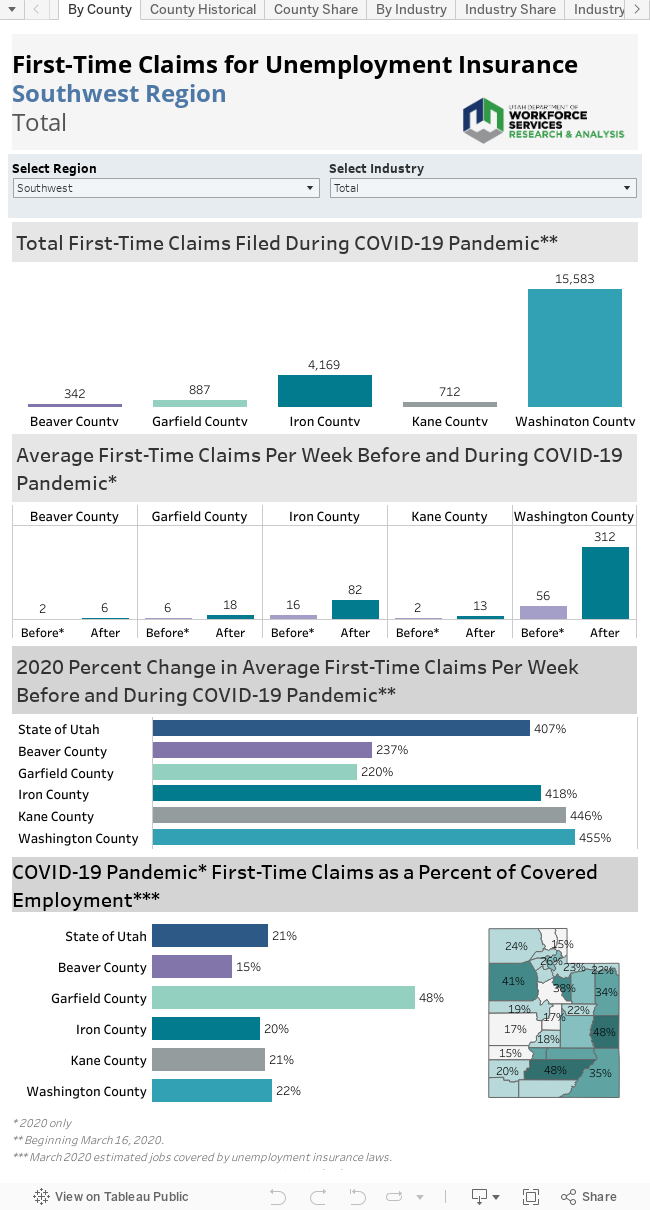
• Prior to the COVID-19 pandemic, Carbon County averaged 10 first-time claims per week, this has now increased to 86.
• First-time claimants, as a share of covered employment in Carbon County, has remained lower than the state average at 8%.
• A majority of the claims filed in Carbon County belong to the healthcare/social assistance sector as elective medical services were halted during the peak of COVID-19 concerns in the area.
• Before the COVID-19 pandemic, Carbon County accounted for 63% of the initial claims for unemployment in the region. It accounted for 75% during the pandemic.
Emery County
• Prior to the COVID-19 pandemic, Emery County averaged six first-time claims per week and has increased to 28 on average in the weeks since.
• First-time claimants, as a share of covered employment in Emery County, has remained lower than the state average at 7%.
• Like much of the state, the majority of the claims in Emery County belong to the accommodation/food services and healthcare/social assistance sectors.
• Before the COVID-19 pandemic, Emery County accounted for 37% of the initial claims for unemployment in the region. It accounted for 25% during the pandemic.
But there is one ray of data illumination. Claims for unemployment benefits are promptly available and provide information about a large cross section of the economy. This post will outline what light unemployment claims data sheds on the state of the Castle Country Region’s economy.
While not all workers are protected by unemployment insurance laws, roughly 95% of jobs are covered. This makes claims data an exceptional source of information about the economy. Not included under unemployment insurance laws are most self-employed workers, about half of agricultural employment, unpaid family workers, railroad personnel (covered separately) and many nonprofit organizations (such as churches). Also, some out-of-work employees may not have worked a sufficient work history to qualify for unemployment insurance benefits, but may file anyway.
Fortunately, in this time of economic distress, the social safety nets of the unemployment insurance program, special national COVID-19 funding and social programs are working together to keep workers’ income and well-being stable.
Unemployment claimants and the unemployed; they aren’t the same
Also, keep in mind that, in addition to individuals drawing unemployment benefits, the unemployment rate includes those entering and re-entering the workforce and non-covered groups without current employment. This means the number of “unemployed” will be greater than the number of claimants. In “normal” times, only about 40% of the “unemployed” are claiming benefits.
The generally reported unemployment rate also has a work-search requirement. If you haven’t made any minimal attempts to find work, you aren’t counted as “unemployed.”
Watch this Space
While this analysis won’t be updated on a regular basis, new data will be added to the data visualization on a weekly basis allowing readers to check back for the latest information.
An Unprecedented Event
Not surprisingly, first-time claims for unemployment benefits soared in Utah and across the nation as the pandemic swept across the country. This increase is unprecedented since the creation of unemployment insurance coverage during the Great Depression. Week 12 (beginning March 16) marks the start of this unparalleled surge in claims. On a positive note, while new claims for unemployment benefits have skyrocketed in Utah, the state currently shows one of the lowest claims rates in the nation.
Emery County saw its peak in first-time claims in week 13 and Carbon County saw its peak in week 14, the first and second weeks after the COVID-19 pandemic hit. Both counties have seen initial claims drop sharply since then. Carbon County, however, did have another uptick in week 19. Both of the Castle Country counties are now down to initial claims levels comparable to those that occurred in 2009 during the Great Recession.
Who took the hardest hit?
The largest industry shares of initial claims filed in the region belonged to healthcare/social assistance. Tourism is the industry suffering the most right now in many areas and accommodation/food service claims also account for over 15% in the region.
In the initial weeks of the pandemic, many claims (135, or 15% in Castle Country) were filed in unknown industry. Most likely many of these can be accounted for by the healthcare/social assistance and accommodation/food services sectors.
Tourism and COVID-19
Especially in the early stages of the restrictions, this is a story of tourism-dependent industries. Approximately 16% of COVID-19 initial claims filed in Castle Country represented workers previously employed accommodations and food services. In Carbon County, 14% of the total claims, and 21% of the claims in Emery County, belong to the accommodation/food service sector.
Industry Flow
While most of the high-claim industries felt the pain of the pandemic early on, other industries surged in later weeks. As the economic effects of other closures worked their way through the economy, wholesale trade proved to be a latecomer to the layoffs in Castle Country, partially responsible for the spike in claims in week 19.
The High and Low
Although healthcare/social assistance and accommodations/food services have generated the largest number of claims in the region during the COVID-19 time period, in percentage terms, other industries have suffered more. For example, 38% of the administrative support/waste management/remediation workforce (which includes temporary employment firms) have filed a claim for unemployment benefits. More than 20% of both the real estate/rental/leasing and management of companies sectors have filed for benefits, as well.
Other industries have been able to hold on to larger shares of their workforces. Construction has seen extremely low filing percentages, as well as manufacturing. Surprisingly, retail trade in Castle
Country also accounts for a small portion of the claims. This is likely due to a large share of the retail trade in rural areas being deemed “essential” and allowed to remain open.
County by County
Carbon County
• Prior to the COVID-19 pandemic, Carbon County averaged 10 first-time claims per week, this has now increased to 86.
• First-time claimants, as a share of covered employment in Carbon County, has remained lower than the state average at 8%.
• A majority of the claims filed in Carbon County belong to the healthcare/social assistance sector as elective medical services were halted during the peak of COVID-19 concerns in the area.
• Before the COVID-19 pandemic, Carbon County accounted for 63% of the initial claims for unemployment in the region. It accounted for 75% during the pandemic.
Emery County
• Prior to the COVID-19 pandemic, Emery County averaged six first-time claims per week and has increased to 28 on average in the weeks since.
• First-time claimants, as a share of covered employment in Emery County, has remained lower than the state average at 7%.
• Like much of the state, the majority of the claims in Emery County belong to the accommodation/food services and healthcare/social assistance sectors.
• Before the COVID-19 pandemic, Emery County accounted for 37% of the initial claims for unemployment in the region. It accounted for 25% during the pandemic.
Monday, March 5, 2018
Utah's Seasonally Adjusted Unemployment Rates
Seasonally adjusted unemployment rates for all Utah counties have been posted online here.
Each month, these rates are posted the Monday following the Unemployment Rate Update for Utah.
For more information about seasonally adjusted rates, read a DWS analysis here.
Next update scheduled for March 26th.
Each month, these rates are posted the Monday following the Unemployment Rate Update for Utah.
For more information about seasonally adjusted rates, read a DWS analysis here.
Next update scheduled for March 26th.
Friday, March 2, 2018
Utah's Employment Situation for January 2018
Utah's Employment Situation for January 2018 has been released on the web.
Find the Current Economic Situation in its entirety here.
For charts and tables, including County Employment, go to the Employment and Unemployment page.
Next update scheduled for March 23rd, 2018.
Find the Current Economic Situation in its entirety here.
For charts and tables, including County Employment, go to the Employment and Unemployment page.
Next update scheduled for March 23rd, 2018.
Monday, April 27, 2015
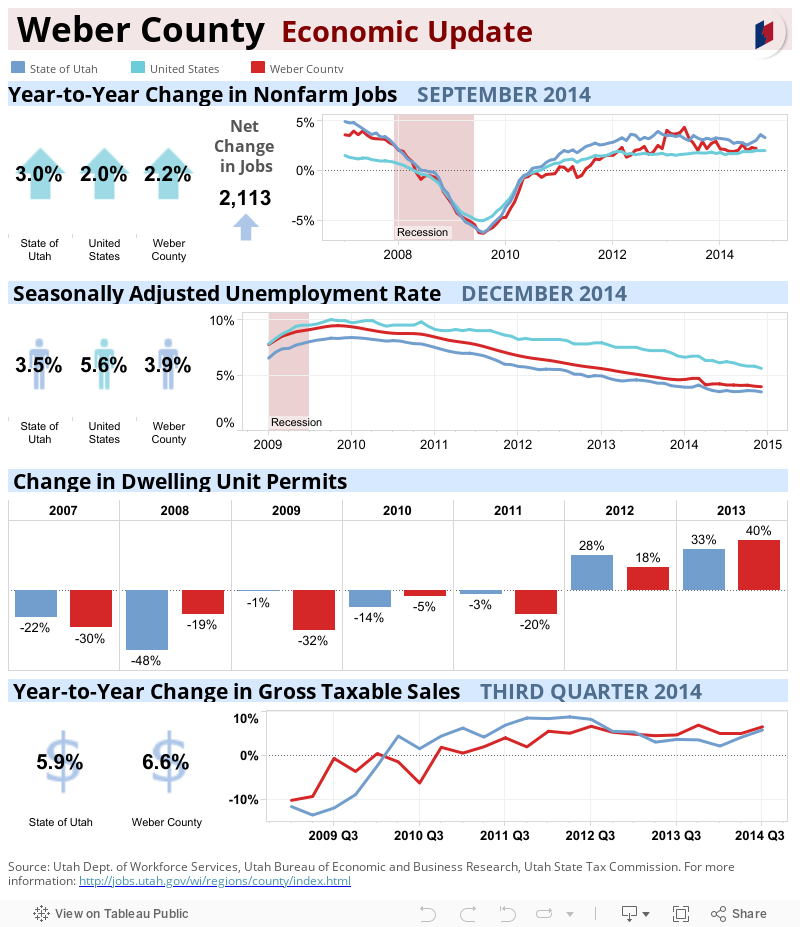
Carbon County Economic Update
Tyson Smith, Regional Economist
The Utah Department of Workforce Services (DWS) relies on several data sources to help describe the state of the economy. The most accurate data available is the nonfarm payroll employment information that is collected through the Quarterly Census of Employment and Wages. However, the resources required to gather data accurately come at the expense of timeliness, which results in a four to six month lag between the time these data are collected and when they are available to the public.
Other data are collected in a timelier manner, and these data (along with historical trends) provide a foundation to estimate current economic conditions. Economists at DWS rely heavily upon statistical models, surveys, and limited datasets to evaluate the economy in real-time. Some of those tools, like the county unemployment rates and initial weekly unemployment claims, are highlighted in this article.
The truth is that no single source of economic data exists that can appropriately profile the labor market in real-time. So, when evaluating regional economies it is important to understand the recent economic history of the area, while also using any up-to-date information available despite the limitations of present data.
Emery County Economic Update
Tyson Smith, Regional Economist
The Utah Department of Workforce Services (DWS) relies on several data sources to help describe the state of the economy. The most accurate data available is the nonfarm payroll employment information that is collected through the Quarterly Census of Employment and Wages. However, the resources required to gather data accurately come at the expense of timeliness, which results in a four to six month lag between the time these data are collected and when they are available to the public.
Other data are collected in a timelier manner, and these data (along with historical trends) provide a foundation to estimate current economic conditions. Economists at DWS rely heavily upon statistical models, surveys, and limited datasets to evaluate the economy in real-time. Some of those tools, like the county unemployment rates and initial weekly unemployment claims, are highlighted in this article.
The truth is that no single source of economic data exists that can appropriately profile the labor market in real-time. So, when evaluating regional economies it is important to understand the recent economic history of the area, while also using any up-to-date information available despite the limitations of present data.
The Utah Department of Workforce Services (DWS) relies on several data sources to help describe the state of the economy. The most accurate data available is the nonfarm payroll employment information that is collected through the Quarterly Census of Employment and Wages. However, the resources required to gather data accurately come at the expense of timeliness, which results in a four to six month lag between the time these data are collected and when they are available to the public.
Other data are collected in a timelier manner, and these data (along with historical trends) provide a foundation to estimate current economic conditions. Economists at DWS rely heavily upon statistical models, surveys, and limited datasets to evaluate the economy in real-time. Some of those tools, like the county unemployment rates and initial weekly unemployment claims, are highlighted in this article.
The truth is that no single source of economic data exists that can appropriately profile the labor market in real-time. So, when evaluating regional economies it is important to understand the recent economic history of the area, while also using any up-to-date information available despite the limitations of present data.
Tuesday, February 10, 2015
Carbon County Economic Update
Regional payroll employment shrinks slightly in the third quarter
Tyson Smith, Regional Economist
Broad-based economic growth does not always portend positive economic conditions in every community. Utah has seen significant labor market expansion over the last four years, growing at an annual rate of about 3 percent since 2011. And yet, economic recovery in the Castle Country region has been less than consistent.
Carbon and Emery counties – which make up Castle Country – have seen changes to the energy sector greatly impact the primary export industry (mining/quarrying/oil and gas extraction) of the region. Export industries generate new income and investment in a region, thus a dramatic change to a local economy’s exports will reverberate throughout the economy.
Carbon County
- Carbon County payroll employment fell in the third quarter of 2014 by an average annual rate of 2.2 percent, the fifth slowest year-over job growth in the state and far slower than the Utah average of 2.8 percent. In total, the county lost 196 jobs from third quarter 2013. Job losses in the mining industry subsided to a rate of 0.4 percent in the third quarter after falling 2.6 percent the previous period. The majority of the decrease in employment came from service-providing industries like wholesale trade (down 25.6 percent) and transportation/warehousing (down 23.1 percent).
- The county seasonally adjusted unemployment rate remained at 4.7 percent in December, 1.2 percentage points above the state average. County unemployment rates are down nearly 1 percentage point from December 2013, and have consistently measured between 4.6 and 4.9 percent since March.
- Initial unemployment insurance claims from January 2015 suggest that county unemployment rates will remain relatively low. The five-week average of initial claims in 2015 was approximately 19 claims per week, compared to 21 claims per week during the same period in 2014.
- While employment in Carbon County waned over the last 12 months, average monthly wages increased 2.5 percent from third quarter 2013 to third quarter 2014. The increase in average wages likely reflects that the jobs lost during the year were lower paying than the jobs retained, which has a skewing effect on the average. The increase in wages probably does not reflect a tightening of the job market, which might result in an increase in wages across the board.
- Third-quarter taxable sales in Carbon County jumped nearly 10 percent, an increase of $9.7 million from last year. Business investment sales in manufacturing surged by $9.2 million (216.7 percent) from third quarter 2013, the largest annual increase in the county. These gains were slightly offset by a $2.5 million decline in the taxable sales of wholesale durable goods.
Emery County Economic Update
Regional payroll employment shrinks slightly in the third quarter
Tyson Smith, Regional Economist
Broad-based economic growth does not always portend positive economic conditions in every community. Utah has seen significant labor market expansion over the last four years, growing at an annual rate of about 3 percent since 2011. And yet, economic recovery in the Castle Country
region has been less than consistent.
Carbon and Emery counties – which make up Castle Country – have seen changes to the energy sector greatly impact the primary export industry (mining/quarrying/oil and gas extraction) of the region. Export industries generate new income and investment in a region, thus a dramatic change to a local economy’s exports will reverberate throughout the economy.
Emery County
- Year-over payroll employment in Emery County shrank 3.5 percent in the third quarter of 2014 after growing 2.5 percent in the second quarter. The decline was driven by the goods-producing industries, which fell 13.9 percent (123 jobs). Mining was hit particularly hard, losing an annual average of 105 jobs from the third quarter of 2013. Private-sector, service-providing employment grew slightly during this period, adding 27 jobs over the year.
- Like Carbon County, Emery County had a relatively high seasonally-adjusted unemployment rate of 4.6 percent in December. Job growth in 2014 has been uneven, and with the impending closure of the Deer Creek coal mine it is unlikely that the jobless rate will reach pre-recession lows in the near future.
- The number of Emery County residents filing initial unemployment claims has been a bright spot for the county. Average weekly claims fell approximately 40 percent in the fourth quarter of 2014, and have continued their downward trend at the beginning of 2015. Falling claims signal that it is doubtful that unemployment rates will increase in January.
- Average monthly wage growth in the third quarter of 2014 reflected the weak employment record; decreasing 0.1 percent from 2013. Carbon County’s wages grew 19.5 percent in the previous quarter, which underscores the variability of quarterly wage data. Wages in Emery County will not consistently have broad-based gains, so long as there remains considerable slack in labor market.
- Third quarter 2014 taxable sales in Emery increased for the fifth consecutive quarter. After increasing by over 15 percent in the first two quarter of 2014, taxable sales in the county edged up less than 1 percent in the third quarter. The manufacturing industry – the third largest industry by taxable sales – increased its business investment sales by $911,000 from the previous year.
Monday, November 24, 2014
Emery County Economic Indicators
Despite the positive momentum across the state, the Castle Country and Southeast regions have scuffled to recover from the recession. Both regions felt the effects of the downturn in 2009, when the labor markets shed 202 and 283 jobs from the previous year, respectively. 2010 turned out to be the best year for the labor market in Castle Country since the recovery began. The Southeast region turned the corner in 2010 and has had uneven job growth since, though the first half of 2014 has shown signs of greater expansion. Some of the issues facing these economies are cyclical; while other challenges – like those facing the mining industry – are longer-term structural shifts in the economy.
- Year-over payroll employment in Emery County grew 2.5 percent in the second quarter of 2014. Growth was driven by the goods-producing industries, which increased 9.7 percent (87 jobs). However, construction and mining employment went in separate directions. Employment in the construction industry jumped 54.7 percent – likely the result of a single project, and not a long-term change – while mining employment fell 23.6 percent.
- Like Carbon County, Emery County had a relatively high seasonally-adjusted unemployment rate of 4.8 percent in September. 2014 job growth has been uneven, and without consistent growth it is unlikely that the jobless rate will reach pre-recession lows in the near future.
- Average monthly wage growth in the second quarter of 2014 reflected employment growth; increasing 19.5 percent from 2013 (the largest increase in the state). Carbon County’s wage growth was broad-based increasing in 9 of the 10 industry groups. However, a single project in the construction industry inflated average monthly wages dramatically.
- Second quarter 2014 taxable sales in Emery increased for the fourth consecutive quarter. Quarterly taxable sales in the county were just under $38 million, compared to $32.7 million in second quarter 2013. The utilities and information industries – the largest and fourth largest industries by total sales – gained $2.4 million combined.
Carbon County Economic Indicators
Despite the positive momentum across the state, the Castle Country and Southeast regions have scuffled to recover from the recession. Both regions felt the effects of the downturn in 2009, when the labor markets shed 202 and 283 jobs from the previous year, respectively. 2010 turned out to be the best year for the labor market in Castle Country since the recovery began. The Southeast region turned the corner in 2010 and has had uneven job growth since, though the first half of 2014 has shown signs of greater expansion. Some of the issues facing these economies are cyclical; while other challenges – like those facing the mining industry – are longer-term structural shifts in the economy.
- Carbon County payroll job growth in the second quarter of 2014 fell to an annual rate of negative 2.0 percent, the fourth slowest year-over job growth in the state and 4.8 percentage points slower than the Utah average. In total, the region lost 178 jobs from second quarter 2013. Employment in the mining industry fell 2.6 percent, but has stabilized somewhat over the last 18 months.
- The county seasonally-adjusted unemployment rate remained at 4.7 percent in September, 1.2 percentage points above the state average. County unemployment rates are down 1.0 percentage point from September 2013, and have consistently been at this level for seven months now.
- While employment in Carbon County waned over the last 12 months, average monthly wages increased 3.0 percent from second quarter 2013 to second quarter 2014. It appears that the jobs lost in several key industries – trade/transportation/utilities, mining, and professional/business services – were lower paying jobs, because these industries all experienced year-over increases to average monthly wages.
- Second-quarter taxable sales in Carbon County stayed relatively unchanged from 2013 to 2014, falling 0.3 percent during the year. Sales in general merchandise retail stores increased by approximately $1.1 million (6.6 percent) from second quarter 2013, the largest annual increase in the county. But, these gains were offset by year-over taxable sales declines in wholesale trade of durable goods.
Tuesday, October 8, 2013
Eastern Region Initial Weekly Unemployment Insurance Claims
A full 13 weeks of third-quarter initial weekly unemployment insurance (UI) claims data have come in for Utah’s eastern counties – Duchesne, Carbon, Emery, Grand, San Juan and Uintah. Initial weekly UI claims for Daggett County were not provided because of its relatively small workforce. The third-quarter weekly average of county UI claims are provided for each year from 2007 to 2013.
Subscribe to:
Posts (Atom)